

ASD Essentials will replace the Essential Eight as the baseline of Australian Cyber Security
For many years, the Essential Eight has been the Australian Signals Directorate’s (ASD) cyber security framework for helping organisations reduce their exposure to common attacks. It focused on eight practical cybersecurity strategies, including patching, multi-factor authentication, restricting administrative privileges, application control and regular backups.
For many businesses, it provides a recognised baseline for protecting systems, identities and information. It also helped organisations prioritise investment, improve recovery and demonstrate their cyber security position to boards, insurers, customers and tender panels.
Recently, a transition has been announced toward to ASD Essentials – building on the Essentials 8 foundation with a broader, evidence-based approach covering enterprise IT, cloud and operational technology environments.
From one single score to domain-based reporting
Instead of relying on one maturity level, ASD Essentials assesses actions across individual domains as:
- Not assessed
- Not effective
- Partially effective
- Fully effective
This gives leaders a clearer picture of where protections are working, where gaps remain and where investment should be directed.
From configuration to demonstrated outcomes
ASD Essentials focuses on whether controls are achieving their intended security outcomes.
Evidence may include patch records, access reviews, monitoring data, security testing, incident exercises and backup restoration results. A configured control without evidence of consistent operation may not be considered fully effective.
Broader coverage and accountability
The framework is organised around principles, actions and domains. It also introduces stronger requirements for executive accountability, cyber resourcing, supplier assurance, AI governance and legacy systems.
What carries over
Existing Essential Eight controls remain valuable. Application control, patching, multi-factor authentication, restricted administrative privileges, macro controls, user application hardening and backups all contribute to ASD Essentials.
Existing policies, configuration records and assessment evidence may also be reused where they are current and relevant.
What does not automatically carry over is the maturity rating. Organisations should use their current Essential Eight position as a transition baseline, then assess how their controls and evidence map to the new domains.
Where to start
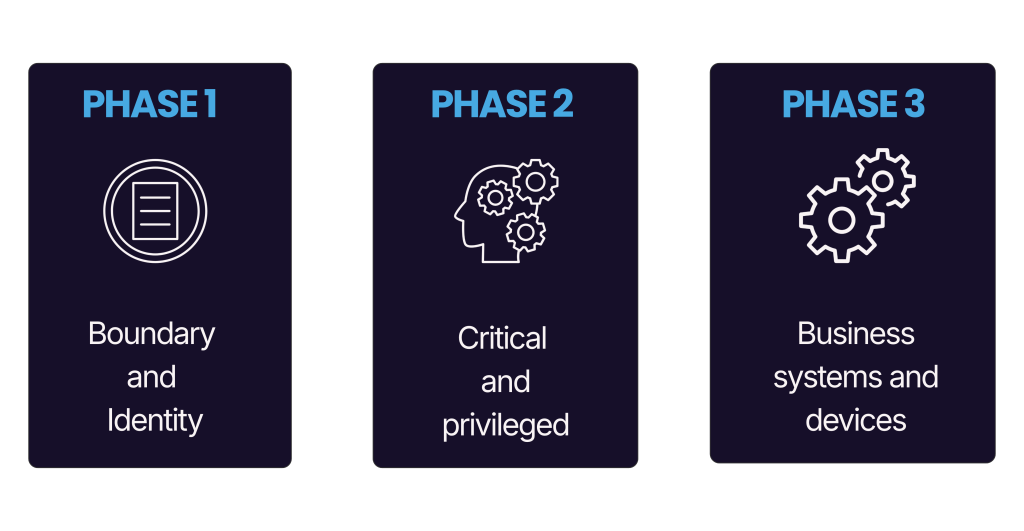
For enterprise IT, the initial priority is boundary and identity services, supported by governance, visibility and response capabilities.
Organisations should:
- Identify and secure every internet-facing system.
- Introduce phishing-resistant multi-factor authentication for administrators and remote access.
- Formally assign executive accountability for cyber security.
- Confirm security events can be detected, investigated and recorded.
- Document current controls, evidence, gaps and accepted risks.
- Map the existing Essential Eight position to ASD Essentials.
What to tell your board
Replace a single statement such as “we are at Maturity Level Two” with a domain-by-domain view showing:
- What has been assessed
- What is effective or partially effective
- What evidence supports each rating
- What gaps remain
- What action is planned
- Who owns the next step
Organisations should continue maintaining their Essential Eight mapping where it is referenced by contracts, tenders, insurers or regulators.
What this means for Interlinked customers.
The move to ASD Essentials is an evolution of Australia’s cyber security guidance, rather than a reason to start again.
For Interlinked customers, the good news is that the investments you’ve already made towards Essential Eight alignment remain valuable. Many of the security controls, technologies and practices already delivered through our managed IT and cyber security services support the principles of ASD Essentials to varying degrees.
While the new framework introduces broader requirements and a different approach to assessment, much of the foundation is already in place.
We’re closely monitoring ASD’s guidance as the transition progresses, including what the changes mean for our customers and their security priorities.
Throughout 2027, we’ll continue to review and evolve our service offerings to reflect the new framework, helping customers understand where they stand, identify any gaps and prioritise the next steps.itsc not
Our advice for now?
Continue investing in good cyber security practices. Thw work you’ve already done matters, and we’ll help you navigate what comes next.